

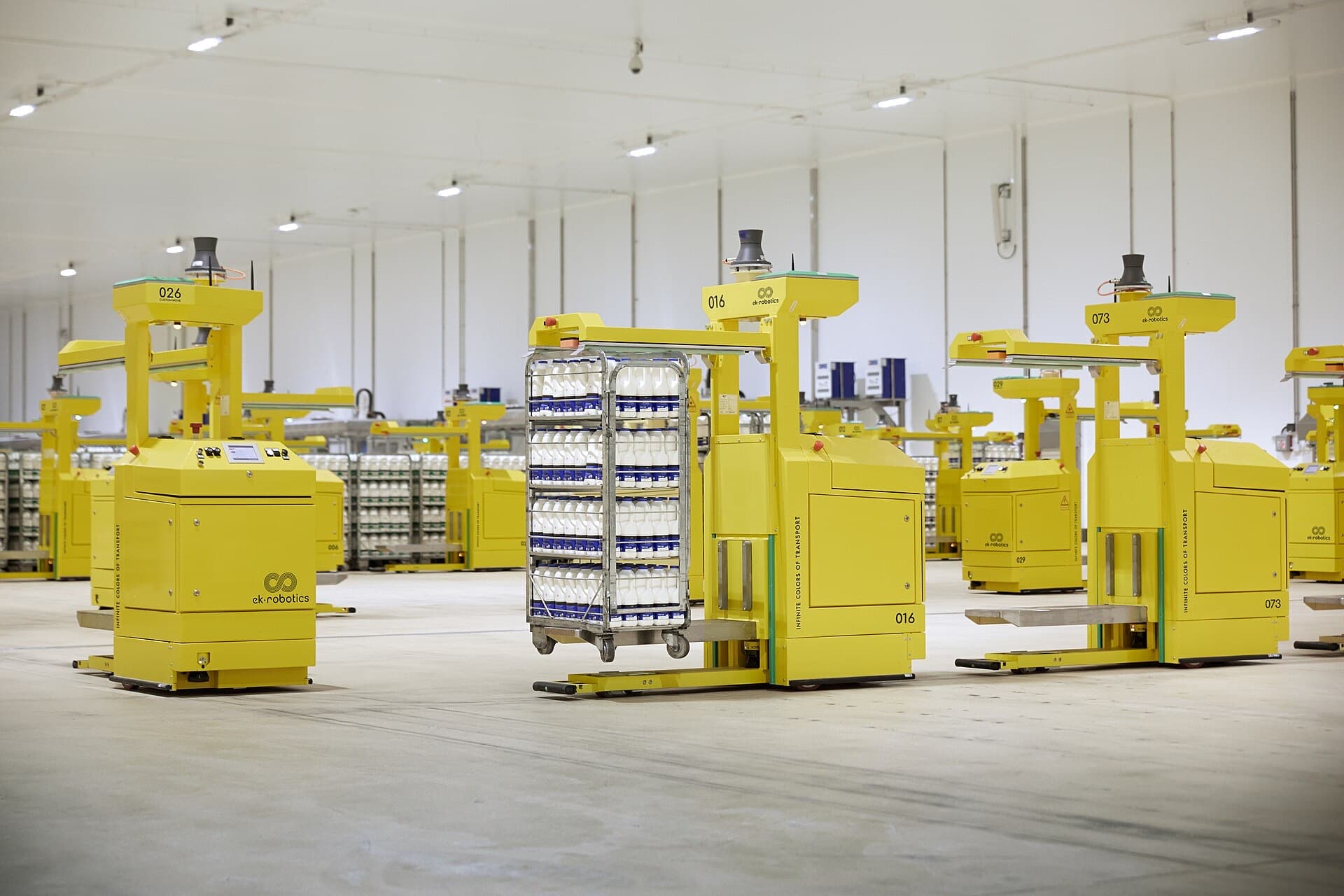
A distribution centre is one of the hardest environments a network can face. Racking ten metres high full of metal and cardboard, forklifts and AGVs that never stop moving, a roof at twelve to fourteen metres, and outside a yard with docks and trailers. Everything that just works in an office has to be designed here.
Why Wi-Fi struggles in a warehouse
Wi-Fi was designed for short distances and clear line of sight. In a warehouse that sight is rarely there. A full rack dampens the signal heavily, and the contents of that rack change every day. A network that measures fine on Monday can have gaps on Thursday because a different batch of goods came in.
The second problem is roaming. A scanner on a forklift passes five access points in a minute. At every transition the device itself decides when to switch, and many scanners do that late. The result is a connection that exists on paper but stutters exactly when an order is being scanned.
The third problem is the ceiling. Access points on a thirteen metre roof are far from the floor and mostly see the tops of the racking. You can mount them lower on the racking itself, but then they sit in the aisle, in the way of forklifts and with a network cable to every point.
What Private LTE does differently
A private mobile network (Private LTE, or Private 5G) runs on licensed spectrum that only you use. There is no interference from the neighbours and no sprawl of channels. One antenna covers a large part of a hall, and the transition between antennas is handled by the network, not the device. That is the difference AGVs and scanners notice: the handover is seamless.
The second advantage is outdoors. The yard around the docks, the trailer parking and the fence are almost impossible to cover with Wi-Fi without dozens of outdoor access points. With LTE it is part of the same network as indoors.
The downside: not every device has a SIM. Laptops, tablets and many older scanners only work on Wi-Fi. And for the office, canteen and meeting rooms LTE is overkill.
The comparison at a glance
| Business Wi-Fi | Private LTE / 5G | |
|---|---|---|
| Spectrum | Unlicensed, shared with surroundings | Licensed, yours only |
| Coverage per antenna | Small, many access points needed | Large, few antennas needed |
| Roaming | Decided by the device, often late | Handled by the network, seamless |
| Yard and outdoors | Hard and expensive | Same network as indoors |
| Devices | Anything with Wi-Fi | Only devices with a SIM or eSIM |
| Capacity per device | High with good design | Predictable, even when busy |
| Best for | Office, canteen, laptops, guests | AGVs, scanners, vehicles, outdoors |
How both networks work together
In practice almost no warehouse chooses one of the two. The combination we build most often looks like this.
- Private LTE for everything that moves and cannot drop offline: AGVs, forklift terminals, scanners, vehicle cameras and the yard.
- Business Wi-Fi for the office, canteen, meeting rooms, guests and the fixed workstations at the packing tables.
- One cabled backbone: the same switches, the same fibre between halls and the same firewall for both networks.
- One management layer: monitoring, incident line and documentation for the whole, so you do not have to work out which network it is when something breaks.
Devices that support both, such as modern scanners with Wi-Fi and LTE, can switch automatically. Indoors on Wi-Fi where that works well, outdoors on LTE as soon as they drive out of the door.
How to decide
Do not start with the technology but with the processes. Which devices must never drop offline? Where do they move? How many will there be in three years? Then we measure on site: a site survey for Wi-Fi and a radio survey for LTE, both with the racking full. Only then do we draw a design, with a fixed price for installation and a monthly fee for management.
Not sure whether Private LTE fits your operation? We build a three month trial with the same hardware as the final network, at a reduced rate. If it works for you, it stays.