

Internet for esports events and LAN parties
At an esports tournament, a lag spike decides who wins and who loses. We build a network with stable latency, a wired connection for every player and a connection to the outside world that fits your event.
Low and stable latency
Above all a ping that does not fluctuate during a match.
Wired for every player
Players play over a cable, not over Wi-Fi. Wi-Fi is for the audience.
A connection that fits
The venue's line, fibre or bonding, or for large tournaments a dedicated fibre line or dark fibre.
Separate networks
Players, stream and production, and the audience each get their own network.
Backup with bonding
If a connection drops, another takes over and the tournament carries on.
Why internet at an esports event is different
At most events, internet is about capacity, enough room for all the phones, tills and uploads. At an esports event or LAN party, latency counts most. That is the time a signal takes to travel from a player's computer to the game server and back. Players see it as ping on their screen.
Even more important than a low ping is a stable ping. A player can live with a ping that is slightly higher, as long as it stays the same throughout the match. It goes wrong with jitter, sudden spikes and packet loss. A player notices straight away, and at a tournament with prize money and an audience watching, that is not something you want to explain.
The connection to the outside: what fits your event
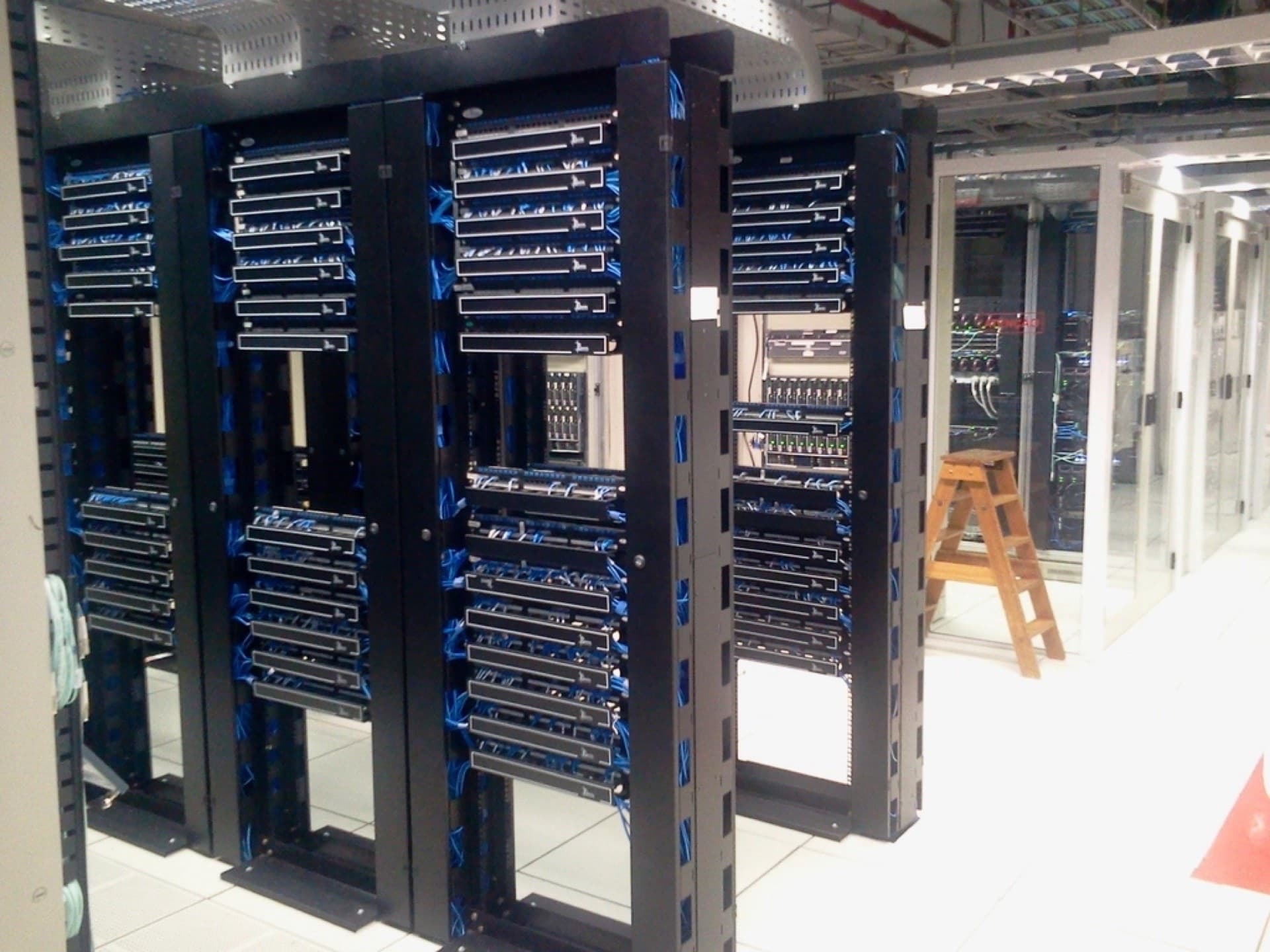
The fewer steps between the player and the game server, the better. Which connection fits best depends on your event and the venue. If the line already in the building is good enough, we only build the network in the hall and connect it to that line. If more is needed, we arrange fibre through one of our more than 80 fibre partners, or we combine several connections into one, which is called bonding: for example satellite internet, 5G, fibre or radio links, with emergency power. A backup is always ready.
At large tournaments where latency matters most, a dedicated fibre line or a dark fibre solution can be the best choice. That is custom work for the largest events, not the default. We survey in advance what is possible at the venue and then choose what fits your event. Read more about fixed connections under business internet.
Playing on servers in the hall
At many LAN parties and some tournaments, matches run on servers in the hall itself. Then the game traffic does not go over the internet, and the local network matters most: fast switches, good cables and no other traffic on the player network. Internet is then mainly needed for updates, launchers, anti-cheat and the stream.
The first hours of a LAN party in particular are heavy: hundreds of participants downloading games and updates at the same time. We take that into account in the capacity to the outside and in how it is shared across the network, so one person's downloads do not get in the way of another person's match.
Wired connections for every player
Wi-Fi is fine for the audience, but not for players. Wireless is more prone to interference, especially in a hall full of phones, and is more likely to cause fluctuations in ping. That is why every player, or every station, gets a fixed cable to a switch used only for the player network.
- A fixed network connection per player or per station.
- Switches used only for the player network, with no other traffic in between.
- A neatly documented set-up, so a broken cable is found quickly.
- Spare connections and spare equipment on site.
At a LAN party with hundreds of participants bringing their own PCs, we design the cabling per row of tables. That way everyone can plug in as soon as they arrive. Read more about cabling and switches under business network.
Separate networks for players, stream and audience
At an esports event, three groups share the same connection to the outside world, and each needs something different. Putting them on separate networks means one group cannot disturb another. A visitor uploading a video must never affect a player's ping.
| Network | What happens | What counts |
|---|---|---|
| Players | Matches, connection to game servers | Low, stable latency and no packet loss |
| Stream and production | Livestream, casters, replays, control room | Plenty of stable upload, all day |
| Audience | Phones, social media | Capacity for many devices, fully shielded |
| Organisation and tills | Registration, payments, crew | Always available, even when it is busy |
The player network gets priority. The audience network has its own ceiling, so a full stand never takes capacity away from the players or the stream. For payments at the bar or merchandise stand, read more under payments and tills.
How we work
From request to live
- 01
Request
You send the dates, the location and what needs to be online. A site map helps.
- 02
Plan
An engineer looks at the location, chooses the connection and makes a design with a proposal.
- 03
Build-up
We build up within your schedule, with emergency power and a backup connection.
- 04
Live
During the event we monitor the network, remotely or with an engineer on site.
Streaming: the upload has to be right
An esports event is often followed online by far more people than are in the room. For many organisers the stream therefore counts as much as what happens in the room. A stream mainly needs stable upload. If the connection fluctuates, quality drops or the picture cuts out.
We give production its own network with reserved upload, connected by cable. If you run several streams, for example per match or in several languages, we include that in the design. We decide how much capacity is needed together with your production team.
Backup with bonding: the tournament carries on
Even the best connection can fail, for example because of roadworks outside the venue. That is why we combine several connections, which is called bonding. Alongside the main connection, 5G and satellite internet, for example, stand ready. If the main connection drops, the others take over the traffic.
The backup does not have the same latency as a fibre line, and we say so up front. The stream does keep running, the organisation stays reachable and matches can often be finished. On top of that, the equipment runs on emergency power. Read more under always online.
How we approach it
We start with the programme: which games, how many players and stations, is anything being streamed and how big an audience do you expect? Then we look at the venue and what is already there.
- Inventory of games, players, stream and audience.
- Survey on site: the connection to the outside and cabling in the hall.
- A design with separate networks and a backup.
- Build-up within the organiser's schedule, with time to test.
- An engineer on site or remote monitoring during the tournament.
Every year we deliver more than 50 temporary connectivity projects. Read more about connecting a temporary venue under temporary internet. Do you also organise hackathons or conferences? See hackathons and conferences. All events are listed under events, and for a proposal, get in touch.
Request a quote
Organising a tournament or LAN party?
Send us the date, the venue, the number of players and stations, and let us know whether you are streaming. We will then tell you how we would approach it.
Every year we provide temporary connectivity for more than 50 projects.
Events that trust us
- Zeezout Festival
- Verknipt Festival
- Liquicity
- World Pride 2026
- Reggae Lake Festival
- Dekmantel
- Lentekabinet
- Bevrijdingsfestival
- Royal Park Live
- The Crave
- Lago Lago
- Sjef
Frequently asked questions
What organisers ask us
Why no Wi-Fi for players?
Wi-Fi is more prone to interference, especially in a room full of phones, and is more likely to cause fluctuations in ping. A cable is predictable. That is why our players always play wired and Wi-Fi is for the audience.
What matters more: a low ping or a stable ping?
Both, but for players a stable ping matters most. Fluctuations and spikes during a match are far more noticeable than a ping that is consistently a fraction higher.
Where does the internet come from?
That depends on your event. If the venue's line is good enough, we only take care of the network in the hall. Otherwise through fibre from our partners or bonding of several connections. At large tournaments it can also be a dedicated fibre line or dark fibre. We decide what fits after a survey in advance.
Can the audience slow the players down?
No. Players, stream and audience are on separate networks. The player network gets priority and the audience network has its own ceiling.
What happens if the connection fails?
A backup connection takes over, for example 5G or satellite internet. It does not have the same latency as fibre, but the stream and the organisation stay online. The equipment runs on emergency power.
Do you also do small LAN parties?
Yes. Whether it is a few tables or a hall full of players, the principle is the same. Send us the number of participants and the venue, and we will make a proposal that fits.
Also relevant for your event
Related services
- Business Wi-FiBusiness Wi-Fi and managed Wi-Fi for offices, schools, healthcare or warehouses: measured, designed and managed.
- Business network (LAN)The wired business network behind your Wi-Fi, cameras and workstations: switches, separate networks and management.
- Business internetFibre or a leased line with the capacity and SLA that fit your business, including a backup where downtime is not an option.
- Temporary internetFast internet at locations without a fixed line: events, relocations, construction sites and temporary premises.
Get in touch with our engineers
Our team in Nijkerk is ready for you
Leave us a message. We would like to hear about your network project, your event or any other question. From Nijkerk we support organisations across the Netherlands.
Your message reaches an engineer, not a sales department.