
Internet and Wi-Fi for sports events
Running events, cycling races, tournaments, motorsport or a match in a sports hall: results must go online instantly, the stream must not stutter and every timing point and till must be reachable. We connect the whole course from start to finish, and give fixed sports venues a permanent network.
Live results
Timing on its own network, so results do not stall when the finish area is crowded.
Course or fixed venue
Radio links and our own mobile network across kilometres of route, or a permanent network in your stadium, sports park or hall.
Upload for the livestream
Reserved upload capacity for the stream and TV production.
Card payments along the route
Catering and merchandise can take cards anywhere, even far from the finish.
Engineer during the race
On site or with remote monitoring, from build-up to the last finisher.
Why internet at a sports event is different
A sports event is rarely a single place. A marathon runs through an entire city, a cycling race covers dozens of kilometres and a triathlon has a swimming venue, a bike course and a running route. Even at a tournament at a sports park or in a stadium, everything is spread across pitches, stands and tents.
At the same time, time matters more here than at almost any other event. Results must go online instantly, the livestream must run without stuttering and the medical posts must always be reachable. Internet at a sports event is therefore mainly about a reliable connection for the people and systems that keep the race running. Wi-Fi for the public comes second.
Which sports events
We provide internet and Wi-Fi for outdoor and indoor sports events, including:
- running events and marathons
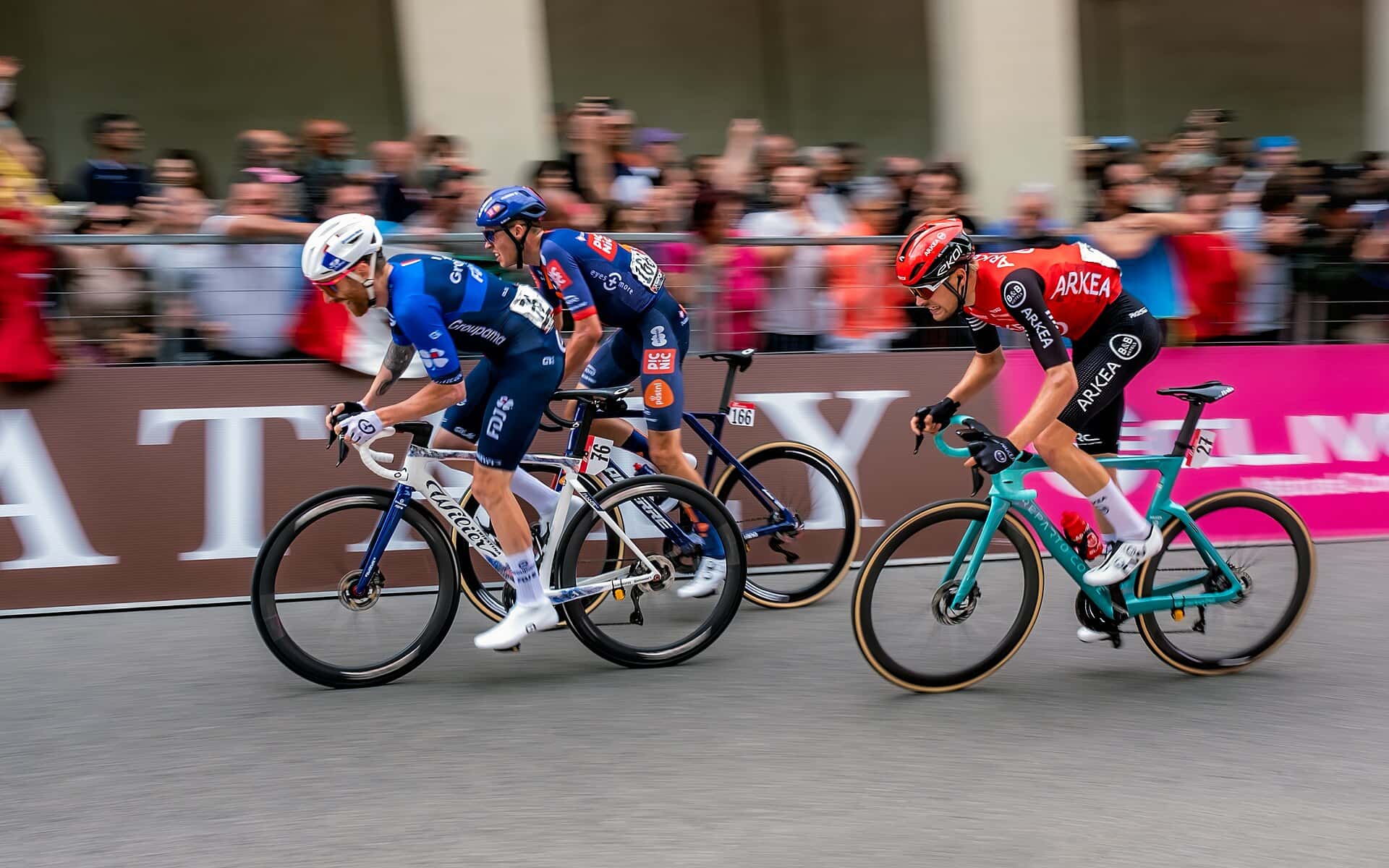
- cycling races and tours
- triathlons
- football and hockey tournaments
- tennis and padel tournaments
- motorsport and racing events
- equestrian events
- water sports and sailing races
- golf tournaments
- skating
- indoor sports events in halls and arenas
On a course the challenge is mostly distance; at a sports park, circuit or hall it is a lot of people in one place. Below you can read how we handle both, and what we do at venues where sport is played every week or every season.
What needs a connection at a sports event
These are the parts that come back at almost every sports event, and where they are.
| Part | What for | Where |
|---|---|---|
| Timing | Sending split and finish times | Start, finish and timing points along the course |
| Live results | Results and standings on website, app and screens | Finish and race office |
| Livestream and TV production | Uploading footage to the control room or streaming platform | Finish, camera positions, outside broadcast truck |
| Catering and merchandise | Card payments | Event area and along the route |
| Crew and race management | Communication, planning, coordination | Everywhere on the course |
| Medical posts | Contact with the central post, registration | Spread along the route |
| Announcer and screens | Live information for the public | Start and finish area, stands |
Timing and live results need a stable connection at the start, the finish and every timing point. We provide that connection. We also make sure the systems of your streaming partner and your till supplier have a connection at every point, and that they do not get in each other's way.
What often goes wrong
At sports events we keep seeing the same pitfalls.
- Timing on the public mobile network. At the finish, thousands of spectators stand with their phones in their hands. Precisely there and at that moment the network fills up and results arrive late.
- A livestream that stutters. Uploading video takes a lot of capacity. On a connection shared with the office and catering, the stream is the first thing to drop.
- Timing points without coverage. A timing point in a wooded stretch, on a dyke or in a tunnel sometimes has barely any mobile coverage.
- Card payments along the route fail. A food truck halfway along the course has no connection, and then it is cash or nothing.
- Medical posts reachable only by phone. When the network is busy, every contact takes longer.
How we connect a course of several kilometres
The heart of the network is usually at the start and finish. There we bring in the connection to the outside world by bonding several connections: satellite internet, 5G and, where possible, fibre or radio links from partners. With emergency power as standard and redundant hardware, the whole set-up keeps running if one of the connections drops out. See always online.
From the finish we connect the course. Over longer distances we use radio links: antennas with a line of sight to each other that bridge several kilometres. Along the route we set up our own mobile network, which is on air within a few hours. Timing points, catering and medical posts get a router or SIM card for that network. Spectators have no influence on it, however busy it gets.
For small, isolated points, such as a refreshment post far from everything else, data SIM cards can also be enough. Which solution goes where, we decide together with you using the course map.
A tournament at a sports park or in a stadium
At a tournament at a sports park or in a stadium the distances are shorter, but the crowds are bigger. Often there is already a connection, but it was built for the canteen and clubhouse, not for a production team, dozens of tills and a livestream at the same time.
Then we build our own network alongside what is already there, or use the existing line as one of the connections. If the venue itself hosts events often, a permanent network is usually the better choice.
How we work
From request to live
- 01
Request
You send the dates, the location and what needs to be online. A site map helps.
- 02
Plan
An engineer looks at the location, chooses the connection and makes a design with a proposal.
- 03
Build-up
We build up within your schedule, with emergency power and a backup connection.
- 04
Live
During the event we monitor the network, remotely or with an engineer on site.
Fixed sports venues: stadiums, sports parks and halls
We also have solutions for fixed sports venues: stadiums, sports parks, arenas and sports halls, ice rinks, race circuits, equestrian centres and golf courses. There we install a permanent network, with cabling and Wi-Fi for visitors, staff, press and catering. You set that network up differently for each event, without a new installation.
- Separate networks for tills and card payments, ticket scanning, press and broadcast, and visitors.
- AI camera surveillance and people counting with radar and ToF scanners, showing live inflow and outflow per zone.
- Management and monitoring after the network has been handed over.
- Does your venue host external organisers? Then you get a webshop in your own branding, where organisers and exhibitors buy connectivity for a set period. You earn on every sale.
Read more under venues and exhibition centres and, for permanent Wi-Fi, under business Wi-Fi.
Separate networks for every function
At a sports event the livestream must never come at the expense of timing, and catering must never get in the way of the medical posts. So every function gets its own network with its own capacity.
- Timing and results.
- Livestream and TV production, with reserved upload capacity.
- Payments and tills for catering and merchandise. Read more under payments and tills at events.
- Crew, race management and medical posts.
- Spectators and participants, if you want to offer Wi-Fi, for example in the start and finish area.
Build-up and during the race
A course through a city is often closed only just before the start. We plan the build-up within your schedule, even when roads only become available at the last moment, so timing points and posts work before the first participant starts. Whatever can be done in advance, we set up earlier.
During the race an engineer is on site, or we monitor the network remotely. If a timing point drops out, we see it immediately. After the last finisher we break down in the order that suits the course, so roads are clear again quickly.
Safety: people counting and cameras
In the start and finish area or on a stand, you want to know how busy it is. Using radar and ToF scanners and our own software, you see live how many people enter and leave a zone, with reports afterwards. See people counting.
AI-powered cameras show where it is getting too crowded and flag when someone climbs a fence. They usually run on our own mobile network, so no cables are needed along the route either. More under AI camera surveillance.
What you arrange as an organiser
- A map of the course with start, finish, timing points, refreshment posts, medical posts and catering points.
- Contact details of your timing company and streaming partner, so we can agree their requirements in advance.
- The build-up schedule and the times when roads or pitches are available.
- Access and power at the places where equipment needs to go.
- The expected number of participants and spectators.
You will find more tips in our checklist for internet at your event and in the overview of internet at events. Also have a look at our temporary internet service, or send your plans straight away via contact.
Request a quote
Quote for internet at your sports event
Send us the date, the location or course and the expected number of participants and spectators. You then receive a proposal from an engineer.
Every year we provide temporary connectivity for more than 50 projects.
Events that trust us
- Zeezout Festival
- Verknipt Festival
- Liquicity
- World Pride 2026
- Reggae Lake Festival
- Dekmantel
- Lentekabinet
- Bevrijdingsfestival
- Royal Park Live
- The Crave
- Lago Lago
- Sjef
Frequently asked questions
What organisers ask us
Can you connect an entire marathon route?
Yes. From the finish we connect the course with radio links and our own mobile network. Which points get a connection exactly, such as timing points, posts and catering, we decide together using the route map.
What does timing need?
Timing and live results need a stable connection at the start, the finish and every timing point. We provide that connection, on its own network. We agree in advance with your timing company what their systems need.
Is there enough upload for a livestream or TV production?
We reserve upload capacity on a dedicated network for the stream, so other users cannot eat into it. How much is needed, we agree with your streaming or production partner.
What if the mobile network is full at the finish?
Your systems are not on that network. Timing, payments and crew run on our own network, and the connection to the outside world consists of several bonded paths. Spectators' phones have no influence on it.
Our sports park already has internet. Is that enough?
Often enough for the clubhouse, but usually not for an event. We look at what is there and, where needed, build our own network alongside it or use the existing line as one of the connections.
Do you also work at fixed sports venues such as stadiums and sports parks?
Yes. We install a permanent network with cabling and Wi-Fi that you set up differently for each event, without a new installation. After handover we manage and monitor it. If you host external organisers, they can buy connectivity from you through a webshop in your branding.
How far in advance should we arrange this?
The earlier the better, especially for a long course where we need to plan radio links. For most events we plan a few weeks ahead. Send us your plans and we will let you know what is feasible.
Also relevant for your event
Related services
- Business Wi-FiBusiness Wi-Fi and managed Wi-Fi for offices, schools, healthcare or warehouses: measured, designed and managed.
- Private LTE & 5GYour own mobile network on your own site, with guaranteed capacity and full control.
- Temporary internetFast internet at locations without a fixed line: events, relocations, construction sites and temporary premises.
- Roaming data SIM cardsSIM cards that automatically connect to the strongest network, in the Netherlands and abroad.
Get in touch with our engineers
Our team in Nijkerk is ready for you
Leave us a message. We would like to hear about your network project, your event or any other question. From Nijkerk we support organisations across the Netherlands.
Your message reaches an engineer, not a sales department.